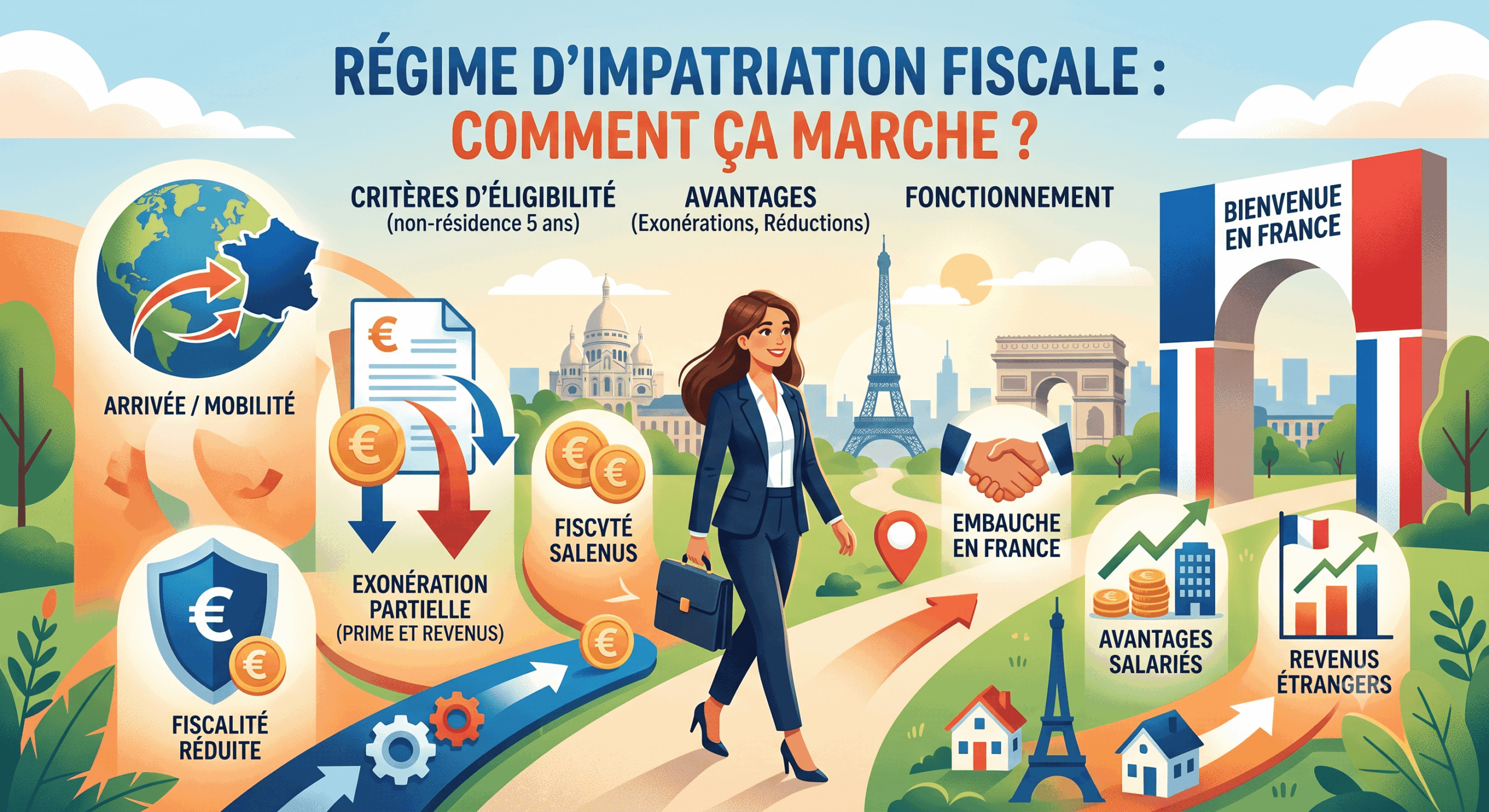
The inpatriate regime (régime des impatriés) is an advantageous tax scheme introduced by France to encourage people living outside France to come or return to France and thus attract foreign talent.
This regime offers tax and social security advantages to inpatriates, thereby facilitating their settlement and integration. In a world where the international mobility of professionals is increasingly common, countries are competing fiercely to attract the best talent.
By introducing the inpatriate regime, France intends to strengthen its attractiveness and help boost its economy by attracting high-level skills.
This detailed article aims to give you an in-depth understanding of the inpatriate regime in France. We will cover the conditions to be met in order to benefit from it, the advantages it offers, the steps to follow to take advantage of it, as well as explanations to optimise your tax situation and make the most of this scheme. We will also draw on concrete examples to illustrate the positive impact of this regime on the lives of inpatriates.
In a context of increasing globalisation, it is essential to understand the tax mechanisms that apply to mobile individuals and to know how to use them to your advantage. The inpatriate regime is an example of a tax policy aimed at facilitating the mobility of talent and promoting the exchange of skills between countries.
Whether you are a French expatriate returning home, a foreign talent wishing to settle in France or an employer seeking to attract international skills, this article will provide you with valuable information and practical explanations to make the most of the inpatriate regime.
We hope that this information will help you better understand the issues and advantages of this tax scheme, and that it will enable you to make informed decisions to optimise your personal and professional situation in France.
Conditions for Benefiting from the Inpatriate Regime
Tax Residence
To benefit from the inpatriate regime, the first condition is to be considered a tax resident of France with significant ties to France. To do so, you must meet the following two cumulative criteria:
- Have your home in France;
- Carry out your main professional activity in France (criteria in a and b of paragraph 1 of Article 4 B of the French General Tax Code (Code général des impôts, CGI); the centre of economic interests alone is not sufficient).
The Period of Non-Residence for Tax Purposes in France
The second condition is to have been a non-resident of France for tax purposes for at least five consecutive years before your return and your hiring. This period of absence must be proven by supporting documents (foreign tax returns, foreign tax assessment notices, school certificates for children abroad, actual residence abroad, etc...).
The Employment Contract
Finally, to benefit from the inpatriate regime, you must be hired by a company established in France under a duly drawn-up employment contract. Company executives may in principle also benefit from the regime, provided that they are employees or treated as employees and meet the other conditions.
The Advantages of the Inpatriate Regime
Exemption of Inpatriation Allowances
Inpatriation allowances, also known as inpatriation bonuses (primes d'impatriation), are sums paid by the employer to offset the costs associated with international mobility and also as an incentive. Under the inpatriate regime, these allowances are exempt from income tax on a flat-rate basis up to 30% of salary, or for their actual amount. The exempt amount is capped by reference to what is known as the reference salary: this is the average salary for the same type of position.
Example: An inpatriate receives a total salary of €100,000, including €40,000 of inpatriation bonus. The average salary for the same type of position is €50,000. Conclusion: no problem, the remaining taxed amount of €60,000 (100,000 - 40,000) is higher than the reference salary, so the inpatriation bonus is exempt without any cap. If the average salary for this same type of position had been €80,000, there would have been a cap: the taxed amount, i.e. €60,000, is lower than €80,000, so part of the inpatriation bonus could not have been exempted: 40,000 - (80,000 - 60,000) = €20,000
Exemption of Income from Professional Activity
Inpatriates may, under certain conditions, benefit from a partial exemption of their income from professional activity for the portion of the activity carried out outside France.
As a practical rule, the portion of salary that can be exempted (inpatriation bonus + activity outside France) is capped at 50% of total salary (or, by election, the portion relating to activity outside France is capped at 20% of taxable remuneration).
Moreover, here again, as we saw earlier, only the portion of remuneration exceeding the average remuneration for a comparable position in France can benefit from this exemption. These rules are not necessarily very clear. Here is a concrete example:
A person resident in Belgium is invited by a French company to come and work in France.
His position: international project manager. He will be required to work in France but also extensively abroad. His total salary will amount to €90,000 per year (including an inpatriation bonus of €20,000 per year). The average salary for this type of position is €70,000 per year.
Conclusion: the inpatriation bonus does meet the conditions to be exempt: it does not exceed 50% of total income (90,000 x 50% = 45,000) and the salary paid to him apart from the inpatriation bonus does correspond to the average salary for this type of position.
If his total salary had been €140,000 (including €80,000 of inpatriation bonus), part of the bonus could not have benefited from the exemption because it exceeds 50% of total income (140,000 x 50% = 70,000). Moreover, his salary other than the inpatriation bonus (140,000 - 80,000 = 60,000) is below the average salary for this type of position, so there is a cap there as well.
Exemption of Foreign-Source Income
Under certain conditions, inpatriates may also benefit from a 50% income tax exemption on foreign-source income (dividends, interest, capital gains) and investment income.
Example: an inpatriate receives €6000 in dividends paid by a foreign company: only €3000 will be taxed, the other €3000 will be exempt from tax. Please note, however, that social levies (prélèvements sociaux) of 18.6% (17.2% before 2026) still apply to the full amount.
Social Security Advantages
Inpatriates may also, under certain conditions, benefit from a temporary exemption from compulsory affiliation to the old-age insurance scheme (Article L. 767-2 of the French Social Security Code (code de la sécurité sociale)); the tax exemption under Article 155 B does not, in itself, extend to social security contributions.
Steps to Benefit from the Inpatriate Regime
The Income Tax Return
To benefit from the inpatriate regime, you must indicate it on your income tax return. You will need to complete income tax return no. 2042 and the supplementary return no. 2042 C.
Boxes to complete:
Exempt salaries and bonuses: 1 DY or 1 EY
Foreign interest and dividends exempt at 50%: 2 DM
Exempt capital gains on sales of shares: 3 VQ
The net taxable salary after deduction of the exempt portion must be entered in boxes 1AJ or 1BJ of the main return 2042.
If the inpatriate opts for the flat-rate (rather than actual) assessment of the bonus, they must indicate this in the "other information" (autres renseignements) section of the overall income tax return (the 2042).
Supporting Documents to Provide
To prove that you meet the conditions of the inpatriate regime, you will need to provide supporting documents to the tax authorities, at their request. Here are the main documents to provide:
- Proof of tax residence in France (lease agreement, electricity bills, etc.);
- Proof of your absence from France for at least five consecutive years (certificates of residence, foreign tax returns, etc.);
- A copy of your employment contract;
- Documents evidencing your inpatriation allowances and your income from professional activity (payslips, employment contract, etc.).
- A certificate from the employer regarding the average reference salary for the same position
- proof of the activity carried out abroad
Applying for the Exemption of Foreign-Source Income
If you wish to benefit from the exemption of foreign-source income, you will need to apply for it to the tax authorities; this application takes the form of correctly completing the various tax returns required to benefit from the inpatriate regime. To this end, it is preferable to consult a tax lawyer to help you complete the necessary forms and gather the supporting documents.
Steps to Benefit from the Social Security Advantages
To benefit from exemptions from social security contributions, you need to contact the Urssaf (l'Union de Recouvrement des cotisations de Sécurité sociale et d'Allocations familiales, the body that collects social security and family allowance contributions) and provide the requested supporting documents. A specific form must be completed to apply for these exemptions.
Explanations to Make the Most of the Inpatriate Regime
Engage a Tax Lawyer
It is strongly recommended to consult a tax lawyer to assist you with the steps relating to the inpatriate regime. This professional will be able to help you optimise your tax situation while complying with legal obligations.
Anticipate the Administrative Formalities
To avoid delays and complications, it is important to anticipate the administrative formalities relating to the inpatriate regime. Prepare the necessary documents in advance and find out about the deadlines and procedures to be followed.
Fully Understand the Advantages of the Regime
Take the time to fully understand the advantages offered by the inpatriate regime and the conditions for benefiting from them. This will enable you to make the most of this scheme and avoid errors or omissions that could jeopardise your tax advantages.
Adapt Your Personal Situation
The inpatriate regime is suited to a variety of personal and professional situations. Take the time to analyse your situation and identify the specific advantages from which you can benefit. For example, if you have investments abroad, you could be eligible for a tax exemption on foreign-source income.
Keep Track of Changes in Legislation
Tax legislation changes regularly, and it is crucial to stay informed of changes that could affect the inpatriate regime. Regularly consult government websites and specialist publications to keep abreast of legislative and regulatory developments.
A Success Story Thanks to the Inpatriate Regime
To illustrate the advantages of the inpatriate regime, let us take the example of Sophie, a French executive who worked in the United States for six years.
On her return to France, she was hired by a French company with an annual salary of 100,000 euros. Her position involves regular business travel abroad. The average remuneration for the same type of position amounts to €48,000.
Thanks to the inpatriate regime, Sophie can benefit from a tax exemption on 50% of her salary, as she combines inpatriation bonuses with activity abroad.
In total, Sophie benefits from a tax exemption of 50,000 euros, considerably reducing her tax liability.
Conclusion
The inpatriate regime is a very advantageous scheme for people returning to France after a period of expatriation or for foreign talent wishing to settle in France. To benefit from it, it is essential to meet the required conditions, to complete your income tax return correctly and to keep the necessary supporting documents in case the tax authorities request them.
With this detailed article, we have covered the various aspects of the inpatriate regime in France. We have discussed the conditions for benefiting from this regime, the advantages it offers, the steps to follow to take advantage of it and explanations to make the most of this scheme. With these explanations, and by keeping informed of changes in legislation, you will be in a position to make the most of the inpatriate regime and to facilitate your settlement and integration in France.
It is also important to stay informed of any legislative changes that could affect this regime and to adapt your personal and professional situation accordingly. Finally, do not hesitate to call on professionals such as a tax lawyer to assist you with the formalities and ensure that you take full advantage of the benefits offered by this regime.